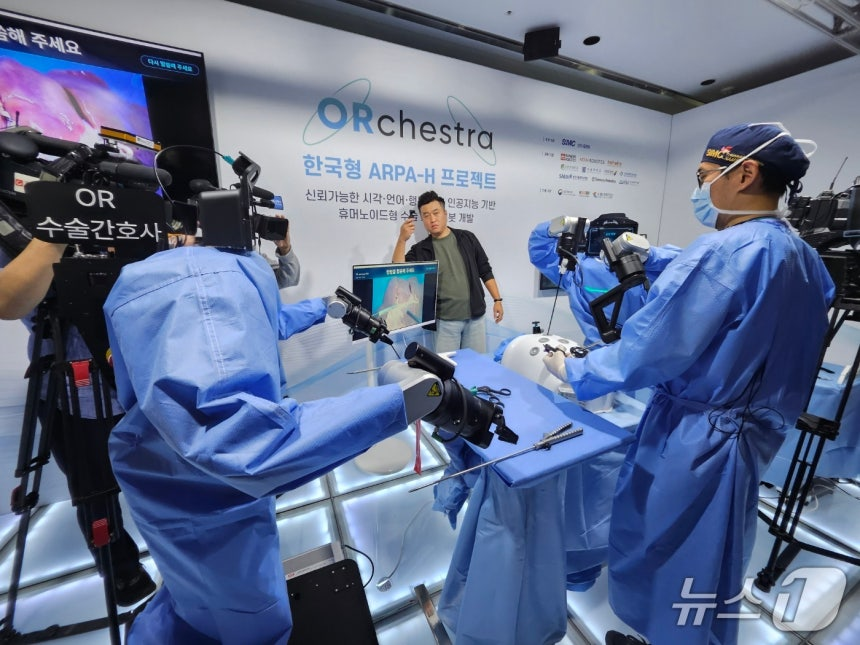
“Give me the scissors.”
As soon as the lead surgeon finished speaking, the robotic arm moved. Picking up the scissors from among the surgical instruments on the tray, the robot brought them straight to the doctor.
A moment later, it happend the other way around.
“Take the tool.”
This time, it received and organized the surgical instrument that was done being used.
It all happened in a matter of seconds. While this is a familiar scene in operating rooms, the one responding to the lead surgeon’s request on this day was neither a nurse nor a resident. It was a humanoid robot operating alongside a human.
On the 16th, at the Samsung Life Ilwon Station Building in Gangnam-gu, Seoul, human doctors and two humanoid robots formed a team to reproduce a cholecystectomy (gallbladder removal) at the humanoid surgical assistant robot demonstration hosted by Samsung Medical Center.
Instead of a human, a goat’s liver was placed on the operating table. On the laparoscopic screen, the structures of the gallbladder and blood vessels were shown in real time; one robot played the role of a nurse handing over surgical tools. The other served as an assistant doctor, holding the laparoscope to maintain the field of view while retracting tissue.
The lead surgeon commanded the robots purely by voice: “Closer.” “A little deeper.”
With every command, the robot adjusted the position of the laparoscope and retracted the tissue. The lead surgeon dissected the gallbladder, clipped and ligated the blood vessels, and excised it in the exact same manner as an actual surgery.
The robot that appeared in this demonstration is the result of the ‘ORchestra’ (Operating Room Collaborative Humanoid) project, which is being developed with the goal of creating humanoid surgical assistant robots that work alongside medical staff in the operating room. Supported by the Ministry of Health and Welfare’s Korean ARPA-H project, the initiative is led by Samsung Medical Center, with participation from Rainbow Robotics, Aidin Robotics, Seoul National University, Sungkyunkwan University, the National Cancer Center, and Jeonbuk National University Hospital.
The demonstration was less about unveiling a finished product and more about previewing a scene from the operating room of the future. However, the significance revealed on site went beyond a simple showcase of research outcomes. As a collaborative structure where medical staff give directions and humanoids respond was realized in an actual surgical scenario, the outline of the future operating room envisioned by the research team took concrete shape.
The research team compared this to the movie Real Steel. Just as a robot that learned human movements conducts boxing matches in the film, humanoids learn the movements of medical staff and apply them to operating room tasks.
Jung Yong-gi, a professor of Otolaryngology at Samsung Medical Center, said, “The humanoid surgical assistant robot converts the movement of human hands and arms into a robot coordinate system and executes them inside the operating room. Through this, we will be able to see precise surgeries where the medical staff’s control inputs are expressed in units of motion.”
“Turning the Operating Room into a Data Factory”… Learning Even the Doctor’s Hand Gestures
The core of the project is not simply about moving robotic arms. The research team is transforming the operating room itself into a “Surgical Data Factory.”
Professor Jung explained, “A process is needed to convert the tacit knowledge doctors have built up through physical surgical practice into data.”
Cameras on the operating room ceiling record the movements of the medical staff. Fine movements of hands and fingers are gathered using wearable sensors. Laparoscopic video is organized into “Action Triplets,” which denote the surgical scene, the instrument used, and the surgical step.
Currently, four institutions, including Samsung Medical Center, are accumulating data in a standardized manner. After obtaining consent from surgical participants, the data undergoes an anonymization process before being used for AI training. The data gathered this way goes far beyond simple tasks like “pick up the scissors.” The research team has already developed and published a paper on an algorithm that predicts the next surgical step and the necessary instruments when shown laparoscopic video. In the long term, the goal is to prepare required tools before the lead surgeon even asks for them, or to understand the flow of the surgery to provide natural assistance.
There is still a long way to go. Professor Jung noted, “Currently, if shown a surgical scene A, the AI can predict the next action quite accurately, but it is not yet at a level that reflects the subtle differences in technique between doctors. Ultimately, a foundation model that understands the full context of the operating room is required.”
Elon Musk’s “Replacing Surgeons Within 3 Years”… How Far Has Reality Come?
Questions from reporters on this day naturally led to discussions on global competition. Attention was particularly drawn to the background behind Elon Musk’s comment last year that “AI will replace surgeons within 3 years.” Professor Jung remarked, “It is not an unfounded statement.”
Indeed, last year, the SRT-H (Surgical Robot Transformer-Hierarchy) study—where AI performed a gallbladder removal on a pig—was published in the international academic journal Science Robotics. However, the experiment was conducted on excised organs rather than live animals.
Additionally, in July of this year, researchers at UC San Diego published results in the journal Nature showing a humanoid robot performing surgery on a pig model via remote teleoperation.
Professor Jung explained, “Elon Musk’s statement is best understood as a symbolic declaration. It doesn’t mean surgeons will disappear in three years, but rather that we are ultimately heading in that direction.”
He emphasized, “In the study published in Nature, the humanoid was remotely operated and human personnel provided surgical assistance. Our setup—a surgical team composed of a teleoperated robot alongside two humanoids—is a world first.”
He also expressed confidence regarding Korea’s standing. Oh Nam-gi, a professor of Transplant Surgery at Samsung Medical Center, said, “Cases where actual medical staff and multiple robots form a team to collaborate are rare globally. If medical staff with sophisticated surgical skills join forces with robot and AI technology, this is a field Korea can fully lead.”
Beyond the Lab to the Real Operating Room: The First Step Toward Clinical Trials in 2029
The research team is currently conducting technical validation with approximately 1.4 billion KRW in Phase 1 funding. If they pass the competitive evaluation scheduled for the end of this year, they will secure an additional research budget of around 12 billion KRW. The total project size, based on government-supported R&D funding, is around 13.8 billion KRW.
Professor Jung explained, “This amount covers not only robot development, but also clinical trials, safety verification, legal and policy research, usability evaluation, and demonstration costs. It is not a structure where the government bears all costs; individual institutions are also making their own investments.”
Questions followed regarding economic feasibility after commercialization—specifically, whether humanoids would actually be cheaper than humans once brought into real hospitals.
The research team believes there will be sufficient economic viability in medical settings where staff shortages are worsening. Professor Jung said, “To maintain a 24-hour presence, you actually need more than 5 people, not just one. If a humanoid can perform at the level of a single nurse, it won’t take long to recover the investment.” However, he added, “The premise is that the robot must secure enough performance to truly replace human roles.”
The first target timeline presented by the research team is 2029. They plan to enter clinical trials on actual patients starting with relatively low-risk roles, such as maintaining the endoscope and securing the field of view. From there, they will expand the scope to tissue retraction and surgical assistance. High-difficulty techniques like incision and suturing are expected to require more time.
Nevertheless, the research team emphasized that their direction is clear: creating a new team member that collaborates with humans, rather than a robot that drives humans out of the operating room.
Professor Jung stated, “If humanoid surgical assistant robots can help humans in environments where surgery is difficult or in areas involving repetitive and exhausting labor, we can create a better surgical environment for patients. We expect this to allow for more stable surgical operations with limited medical personnel, and to fill workforce gaps in nighttime, emergency, and essential medical care where securing skilled surgical assistants is difficult.”
Source: “Scissors, please”: Humanoid robots enter the operating room (2026.09.17), News1, Chun Sun-hyu www.news1.kr/bio/general/6293528