

Your best machinist just gave notice. You have twelve part numbers running this month, two CNC lathes, and an order you would like to take but cannot staff. At noon, both spindles stop for lunch. At five, they stop for the night.
Most shops in that spot do one of three things: chase hires that take months to train, send overflow work to outside shops, or turn the order down. There is a fourth option many owners never consider, because they assume automation is for big plants running the same part all year. It is automating machine tending with a collaborative robot.
What is machine tending?
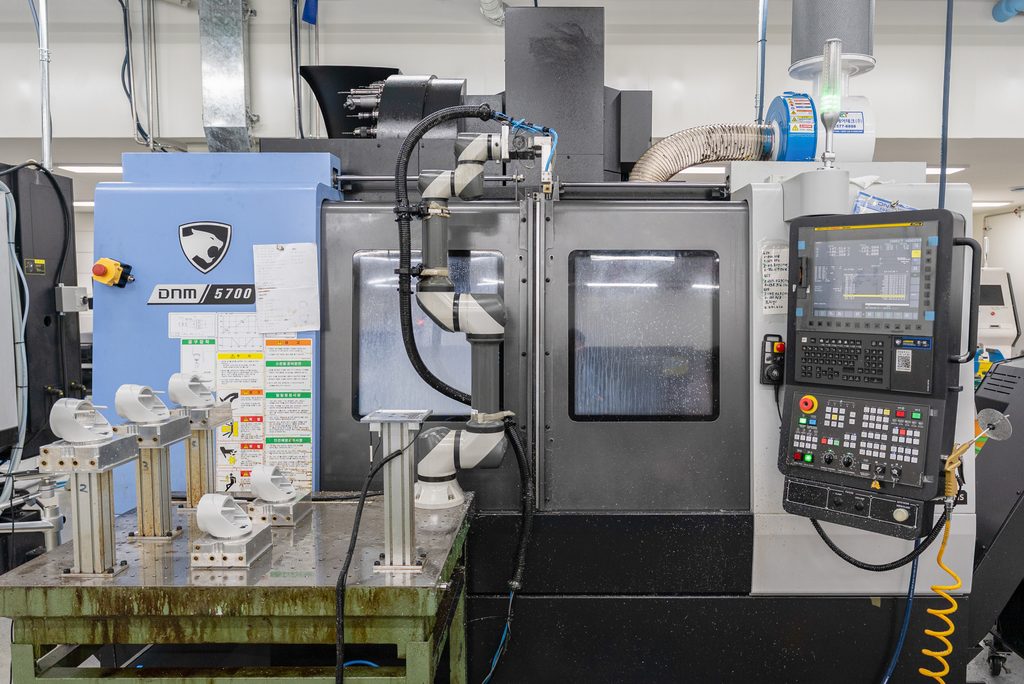
Machine tending is the job of loading raw parts into a machine tool, such as a CNC lathe, machining center, press or injection molding machine, and unloading finished parts. Automating it keeps machines running through lunch and shift changes, and frees operators for work that needs a person.
While a cycle runs, anywhere from 30 seconds to over three minutes, the operator waits on the machine. When one operator runs several machines, the machines wait on the operator instead. Either way, someone’s time is wasted. And repeating the same motion all day puts strain on wrists and backs. Hand this job to a robot, and machines keep running through lunch and shift changes while operators focus on the work that needs a person.
What does a machine tending robot actually do?
A machine tending cell repeats the same four steps an operator does today.
- Pick. The robot picks a blank from a tray or bin, recognizing each part’s shape and position.
- Signal. It exchanges signals with the CNC to open the door and confirm the machine is ready.
- Load and start. It places the blank in the chuck or vise, closes the door and starts the cycle.
- Unload and stack. When the cycle ends, it removes the finished part, blows off coolant, and stacks it in a set position.
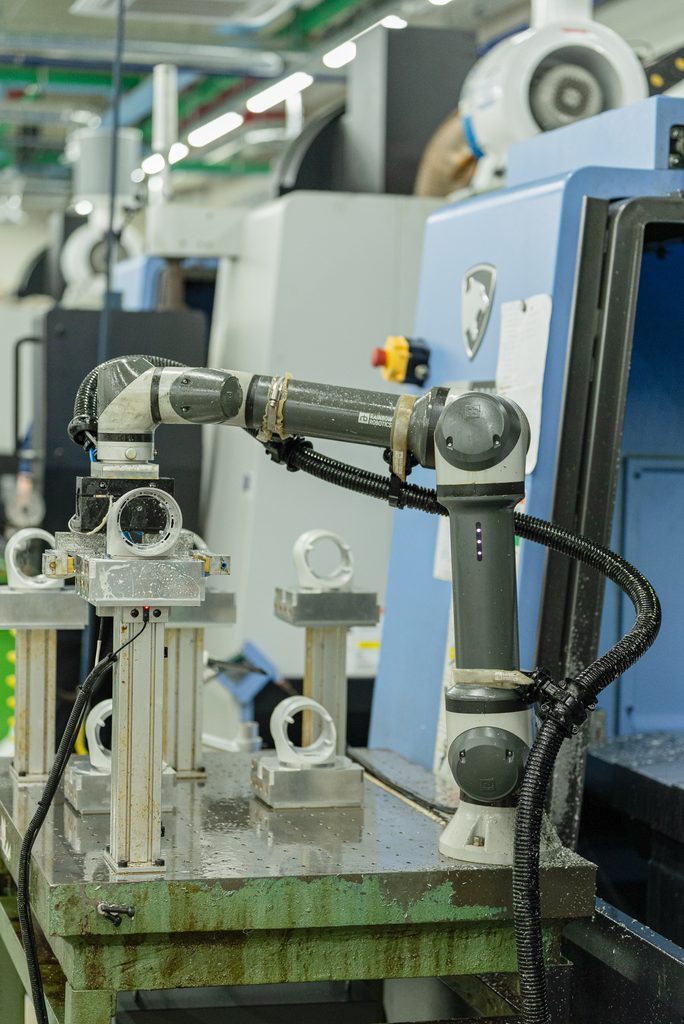
While the robot takes over the open, load, close, wait, unload loop that fills an operator’s shift, your people focus on the work that needs experience and judgment: choosing the right tooling and clamping force for each material and shape, adjusting offsets, and editing machining programs.
Which machines can a robot tend?
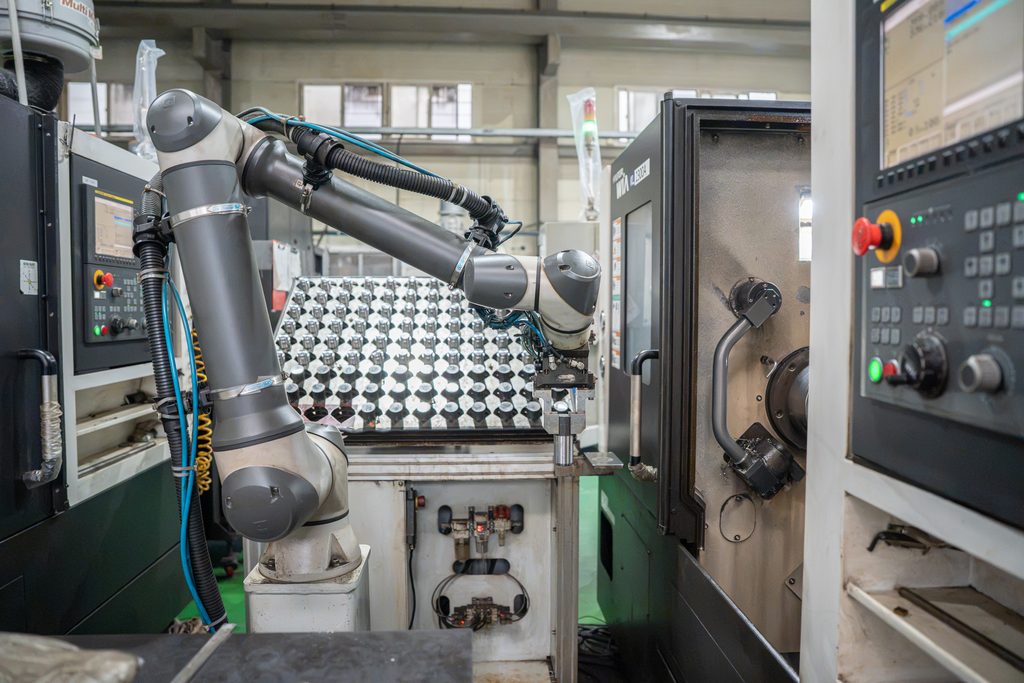
Any machine with a repeatable load and unload point can be tended, including CNC lathes, machining centers, grinders, presses and injection molding machines. This guide focuses on CNC lathes and machining centers, because that is where shops feel the labor gap most and where a single robot can often serve more than one machine.
Why is machine tending a good first automation project?
- It covers the job that is hardest to staff. Loading and unloading is simple but relentless, so it burns people out fastest and has the highest turnover. It is also exactly what robots do best.
- Your existing people and machines produce more. Every minute a finished part sits in the chuck while the operator is on break or at another machine is lost spindle time. A robot keeps going through lunch and shift changes, so the machines you already own produce more.
- Your layout stays. A collaborative robot (cobot) can work alongside people, so you can automate without moving machines. Whether you need extra safeguards such as fencing is decided through an on-site risk assessment.
- The robot is reusable. A cobot is general-purpose equipment. If the work changes, the same robot can move to inspection, deburring or packing.
Can a high-mix, low-volume shop automate machine tending?
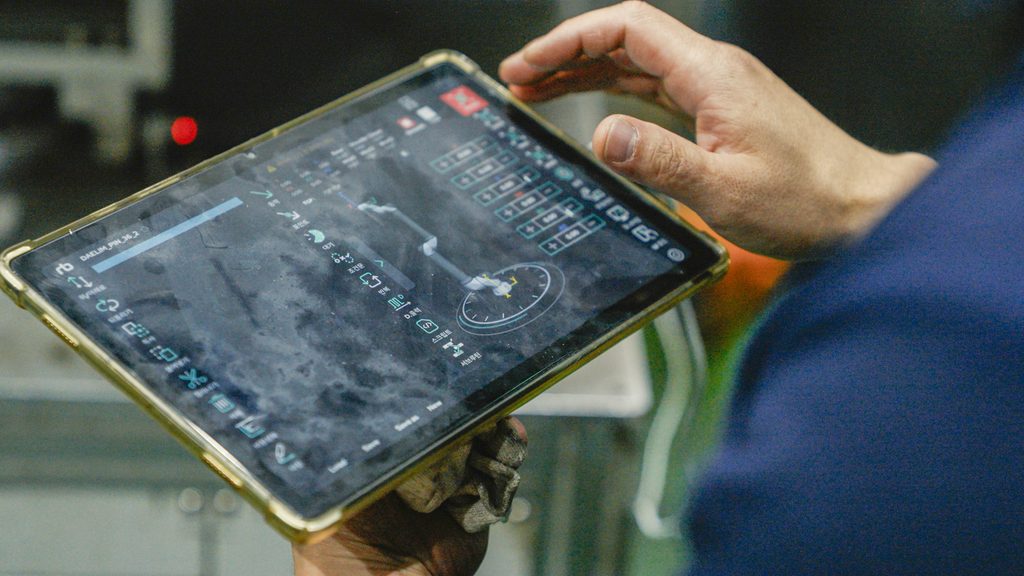
To automate high-mix, low-volume work, programming each part has to be easy. Robot-based machine tending keeps the programming barrier low. Each part number gets its own stored program, so changing jobs means calling up a program, with no added cost to adjust equipment when you switch parts. Rainbow Robotics cobots use a graphical interface, so programming is intuitive.
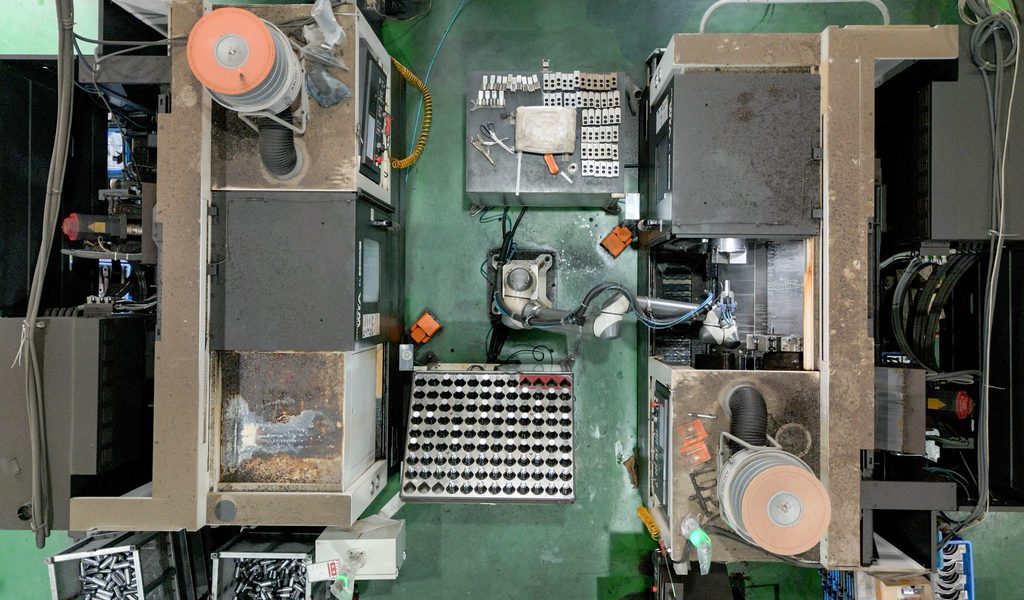
One Korean shop that makes pins and spacers for construction equipment started with two part programs set up with their local distributor. By adapting those programs, they went on to program twelve parts of different diameters on their own. If you know the coordinates, you can edit the program, and they rated the difficulty a 3 out of 10.
What should you look for in a machine tending cobot?
A machine tending robot exchanges signals with machine tools, works where coolant flies, and repeats the same motion countless times a day. So when choosing a robot, we recommend checking these six things.
- Does it connect easily to your CNC? Rainbow Robotics cobots support industrial protocols (Modbus TCP, EtherNet/IP, PROFINET, OPC UA), CNC-maker protocols such as FANUC FOCAS, and PLC-maker protocols such as Siemens S7, Mitsubishi MC and LS XGT, all as standard. One of our customer has told our RB cobot he had zero defects caused by auto-door signal errors.
- Is it sealed against dust and coolant? A machine shop is full of coolant mist and spray, and if the robot breaks down there, the machine stops with it. Every Rainbow Robotics cobot model is rated IP66: fully dust-tight and protected against powerful water jets.
- Does the spec fit your shop? Size the robot by the actual weight it handles: the rated payload minus your gripper and other end-of-arm tooling. With a double gripper, count both parts. Rainbow Robotics cobots range from 1 kg to 35 kg (2 to 77 lb) in payload and from 500 mm to 2,100 mm (20 to 83 in) in reach, so you can match the robot to your machines.
- Can your operators run it? With a graphical interface, motions are set up without writing code, so CNC operators who have never used a robot can add part numbers and adjust coordinates themselves.
- Is it safe to run? Speed limits and collision detection let it work alongside people.
- Is it cost-competitive? The more core components a maker builds in-house, the better it can keep quality up and prices down. Building on the technology behind our HUBO humanoid robot, Rainbow Robotics makes 80% of its cobot components in-house, which lowers the upfront cost. The software is included at no extra charge.
Will it work in your shop?
If three or more of these five apply, machine tending automation is worth a closer look.
- An operator spends most of a shift loading and unloading.
- Your machines sit idle during breaks, shift changes or nights.
- Parts repeat in batches, even if you run many part numbers.
- Your blanks can be gripped and fit within a cobot’s payload.
- You would take more work if you had the capacity.
See if machine tending fits your shop
The benefit Rainbow Robotics customers mention most is not fewer people. It is taking more orders with the team they already have, and growing revenue as a result. Rainbow Robotics does not build robots to replace people. We build robots that let the same team grow the business further.
Rainbow Robotics, the Korean company behind the HUBO humanoid robot, has shipped more than 4,000 cobots to date and works with partners to support customers from installation through operation.
Wondering if a machine tending robot fits your shop? Tell us about your parts and machines, and our engineers will suggest a setup that fits.
▶Talk to an engineer about machine tending for your shop.
